

By George P. Nassos
The 4.5-billion-year-old earth consists of a core which is like a solid ball made up of mostly iron and magnesium. There is also an outer crust made mostly of solid rock rich in iron and magnesium like the core. In the outer crust there are also many other solid minerals like sodium, potassium, calcium and aluminum, and in a much lesser extent the valuable ones like silver, gold, lithium and diamond.
What is more important to the human and animal population is the content of the earth’s surface. From the beginning, the earth consisted of trees, flowers, vegetation, birds, animals, fish, soil and water. The big question is how much is there today and how much can we use? An organization called Global Footprint Network has been calculating and analyzing the ecological footprints of over 200 countries. The footprint refers to the amount of the earth’s carrying capacity it takes to sustain humanity’s consumption of goods and services, basically the
need for food, clothing, shelter, energy, and disposal of waste. According to its calculations, in
the late 1970s, humanity’s collective ecological footprint breached the sustainability mark for the
first time, and it has remained unsustainable ever since. In fact, the deficit for maintaining
sustainability has grown almost every year since then, and it appears that this deficit is on a path to growing further in the foreseeable future. Currently, it is estimated that we need 1.8 earths to ensure that future generations are as well off as we are today.
To give you a better idea of the overconsumption of the earth’s natural resources, here is a table showing the number of acres per capita that were required in 2022 by several countries.
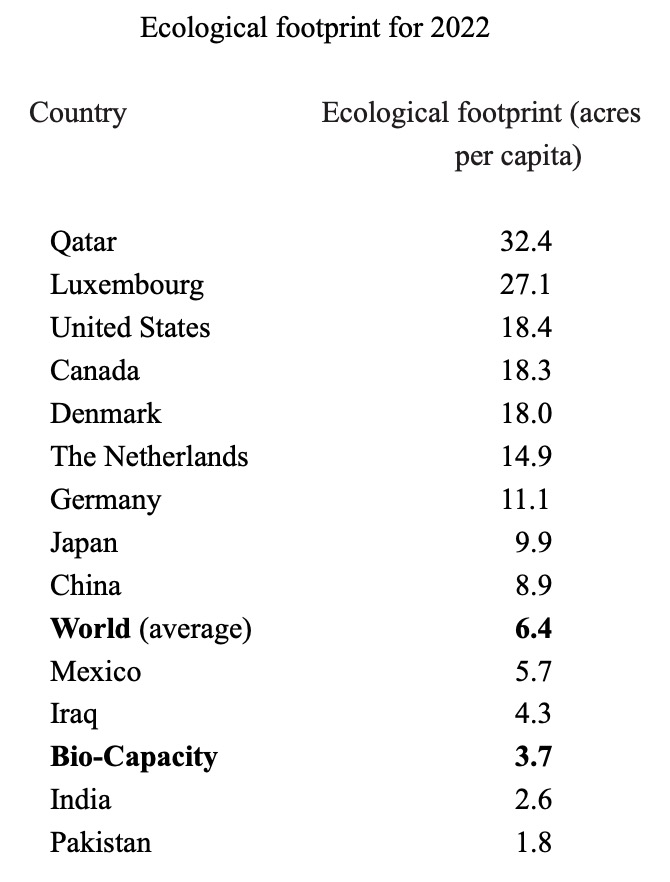
The value shown in bold next to Bio-capacity indicates what the earth generates in one year.
Another metric developed by the Global Footprint Network is Earth Overshoot Day
which marks the date when humanity has exhausted nature’s budget for the year. It means
that for the rest of the year, we are using resources beyond what our planet provides. Last year
Earth Overshoot Day fell on July 24, 2025, a whole week earlier than 2024.
Overshoot days are calculated for individual countries, also. Last year, Singapore
had the earliest overshoot day (January 3), followed by Israel (January 19), the Bahrain
(January 24) and Qatar (January 24). China’s Earth Overshoot Day fell on March 16 and the
United States’ Earth Overshoot Day was on June 30. Lithuania had the latest one on November 28.
If we continue this path, there is no telling what can happen to this planet and when we will see the destruction. The Global Footprint Network is also conducting research to identify ways to solve the overconsumption of our natural resources. Some ideas are to design cities to be more sustainable, reduce energy consumption, feed us more efficiently, and manage population growth more efficiently. On the Global Footprint Network website #MoveTheDate Responding to Overshoot – #MoveTheDate of Earth Overshoot Day there are one hundred ways that Earth Overshoot Day can be made later in the year. Something we can all do is start real soon to minimize waste. When you go grocery shopping, try to avoid the special deals of buying more than you need when you are offered a better price.